

Biophotonics and Nanomedicine Laboratory

Mission.
Development of technologies that can practically be used in a variety of medical applications, such as treatment and diagnosis, with nano-sized optical materials and drug carriers
is the ultimate goal of BNL :
The process begins with the synthesis and fundamental study of nanomaterials, continues with animal and cell experiments, and culminates in clinical trials.
For our research to become a valuable medical tool, we collaborate with BioACTs, DR.Nano,
Seoul National University Hospital, and other leading institutions.

Biophotonics.
Biophotonics denotes a combination of biology and photonics, being the science and technology of generation, manipulation, and detection of photons in biological systems.

Nanomedicine.
Nanomedicine is the medical application of nanotechnology. Nanomedicine ranges from the medical applications of nanomaterials and biological devices to nanoelectronic biosensors.

BIOPHOTONICS
In vitro sensor
Along with the fast population aging, the number of patients with age-related degenerative diseases is also increasing. Therefore, highly selective treatment options and susceptible diagnostic technologies are needed. Our group is developing luminescence-based particles with high sensitivity to detect disease-related makers in the blood, in order to overcome the difficulties associated with conventional blood-based diagnostics.

In vitro diagnostic techniques from blood
We synthesize particles that selectively respond to disease-related factors in the blood, and detect different reactive chemical species that affect the cells while minimizing interference with other blood components like proteins.

Luminescence-based techniques
We detect target factors in the blood at low concentrations by electrochemiluminescence, chemiluminescence, fluorescence, and other luminescence phenomena.

Ultimately, we are developing a diagnostic platform that can monitor multiple diseases simultaneously.
ROS (Reactive Oxygen Species)
RNS (Reactive Nitrogen Species)
RSS (Reactive Sulfur Species)

Reactive chemical species detection for multiple/simultaneous point-of-care testing(POCT) platforms
Molecular imaging
Molecular imaging is a technology that visualizes changes at the molecular level in vivo in real time and is applied to various fields such as drug delivery and disease monitoring. We develop diagnostic technologies based on chemiluminescence and fluorescence for clear and selective in vivo imaging.
Conventional strategy


BNL’s strategy


In conventional diagnostic systems, light irradiation for excitation and imaging by fluorescence which emits light in a short lifetime must be performed simultaneously. However, In our research, we synthesize new materials for imaging that have high sensitivity and selectivity for diseases that minimize autofluorescence by afterglow methods.
NANOMEDICINE
Nanomedicine is a branch of medicine that focuses on the medical application of nanotechnology to overcome the limitations of existing drugs and to improve the stability and effectiveness of treatments by adjusting the delivery and activity of medications in accordance with disease characteristics. Using nanoparticle formulations, we are developing treatments for various cancers, Alzheimer's disease, and aging diseases.
Gene therapy
Gene therapy can restore disease phenotypes to normal by inhibiting abnormal gene expression or replacing abnormal genes with normal ones. We study ways to deliver unstable nucleic acid-based drugs to the target site in vivo using nanoparticles while protecting the nucleic acids from degradation to enhance their efficacy.

siRNA
Nanocarrier
Stabilizer
Gene delivery Nanoparticle
Phototherapy (PDT/PTT)
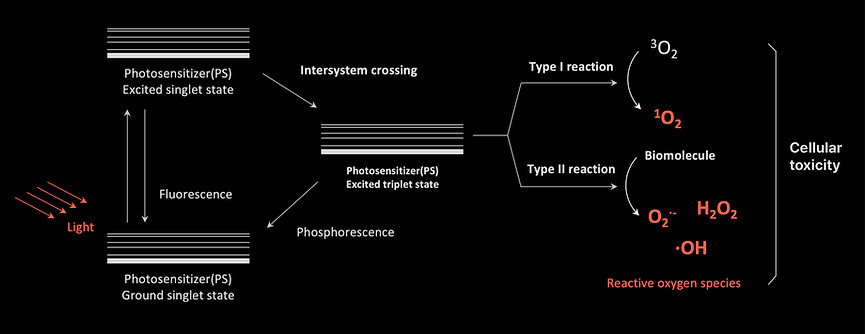
Phototherapy uses light-sensitive agents that absorb light at a specific wavelength and is applied to bioimaging, therapy, and diagnosis. Typically, photodynamic therapy (PDT) involves the use of reactive oxygen species generated by photosensitive agents to remove cells. Our research focuses on the selective delivery of photosensitive agents to disease sites using nanoparticles. We also research photothermal therapy (PTT).

Surfactant
Stabilizer
Photosensitizer
PDT Nanoparticle
Immunotherapy

Immunotherapy is a next-generation treatment that utilizes the immune system in terms of excellent therapeutic effects and stability. Through adjuvants and damage-associated molecular pattern (DAMP) signal secretion, nanoparticles can amplify signals at disease sites and alert immune cells to abnormal cells.